

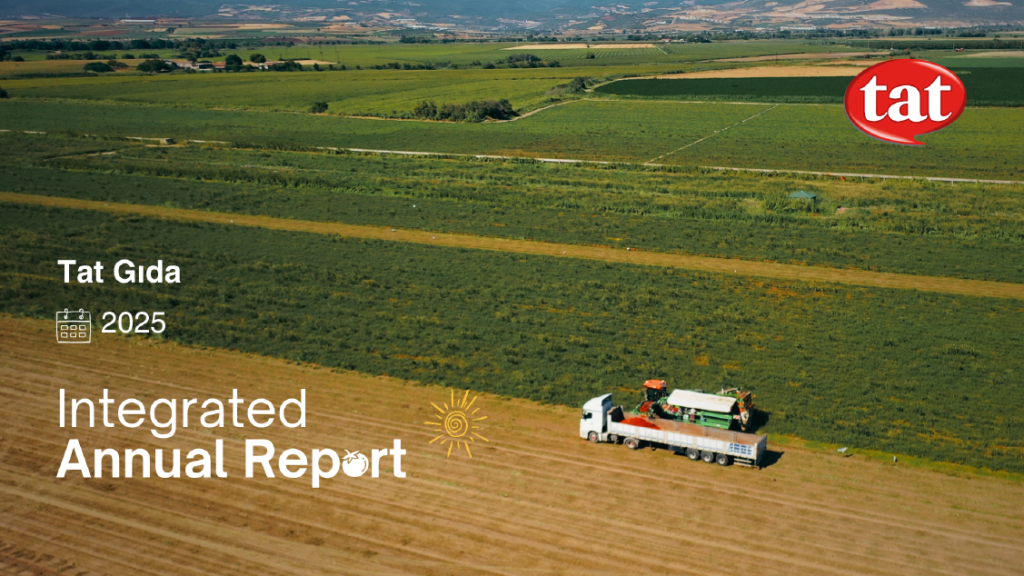
Türkiye’s Tat Gıda, with 58 years of experience, has taken an important step in its corporate reporting approach by publishing its first Integrated Annual Report for 2025. For the first time, the company combined its financial report and the disclosures prepared in line with the Türkiye Sustainability Reporting Standards (TSRS)-aligned Sustainability Report into a single document, offering stakeholders a more holistic and transparent reporting model.
The integrated report, reflecting a next-generation corporate reporting approach, evaluates the company’s financial performance together with its environmental, social, and governance (ESG) performance. In this way, it provides investors, financial institutions, and other stakeholders with a more comprehensive view of the company’s value creation capacity. The Tat Gıda 2025 Integrated Annual Report presents the company’s business model, strategic priorities, governance structure, risk and opportunity management, and sustainable value creation approach within a single framework. This structure makes the relationship between financial results and sustainability performance more visible, while also enabling short-term operational results and long-term growth targets to be evaluated within the same corporate narrative.
The integrated report was prepared in line with newly implemented sustainability reporting standards
Covering a broad product portfolio including tomato paste, tomato products, sauces, ready meals, and canned food categories, Tat Gıda’s first integrated annual report was prepared in accordance with the Türkiye Sustainability Reporting Standards (TSRS), which have recently come into effect in the field of sustainability reporting in Türkiye. In addition to ESG indicators aligned with TSRS standards, the report also includes climate-related risks and opportunities under TSRS S2 “Climate-related Disclosures,” and their potential impacts on the company’s financial performance.
Within this scope, detailed targets and metrics regarding the company’s climate governance structure, strategic approach, risk management processes, and greenhouse gas emissions performance indicators are also included. Bringing financial, sustainability, and climate data under a single report reduces data duplication and eliminates inconsistencies between different reports, creating a more comparable and reliable information base for investors.
“Sustainability and digital transformation are at the center of our business model”
Tat Gıda Chairman of the Board Veysel Memiş stated that the integrated report is an important indicator of the company’s sustainable growth vision, and said:
“Tat Gıda continues its operations decisively in line with its vision of becoming a global food brand emerging from Türkiye, supported by its deep-rooted history in the agriculture and food sector, strong production infrastructure, and high brand value. Thanks to our business model shaped around trust, quality, and sustainability, we build strong relationships with both our consumers and stakeholders.”
Emphasizing that sustainability and digital transformation are among the company’s strategic priorities, he noted that sustainable food supply is not only a current operational necessity but also a strategic responsibility to ensure safe and accessible food for future generations.
Renewable energy investments are accelerating
As part of its sustainability strategy, Tat Gıda is also accelerating its renewable energy investments. The company’s 1.98 MWe Solar Power Plant (SPP) in Akçaköy, Yunusemre, Manisa was commissioned in 2025. With an annual production capacity of approximately 3,800 MWh, the facility currently covers about 19.5% of the company’s total energy consumption from renewable sources.
With the second solar power plant under construction in Dinar, Afyonkarahisar, a significant portion of the company’s energy needs is expected to be met from renewable sources. Tat Gıda also commits to reducing carbon emissions by 55% by 2030 and achieving net zero emissions by 2050, in alignment with the European Green Deal.
Digital agriculture and contract farming model
Digital agriculture applications and the contract farming model also play an important role in the company’s sustainable growth strategy. Tat Gıda collaborates with more than 1,000 farmers, 500 of whom are contracted, to support productivity, traceability, and sustainable farming practices.
Through satellite imaging systems, agricultural sensors, climate stations, and data-driven production models, the company aims to increase agricultural productivity, optimize water and fertilizer use, and reduce environmental impact. The company also contributes to the expansion of data-driven agriculture through young farmer training programs and digital agriculture initiatives carried out in cooperation with the EBRD.
Tat Gıda aims to continue its growth in global markets with its strong production infrastructure and sustainability-focused investments.
The company’s first integrated annual report represents an important transformation in corporate reporting by evaluating financial performance together with sustainability strategies. This approach makes not only current performance but also the company’s future value creation capacity more visible, while providing stakeholders with a transparent, comparable, and holistic reporting framework.
The report centers on key governance principles such as transparency, accountability, responsibility, and fairness, while comprehensively presenting the company’s strategic priorities, risk management approach, and long-term value creation model.